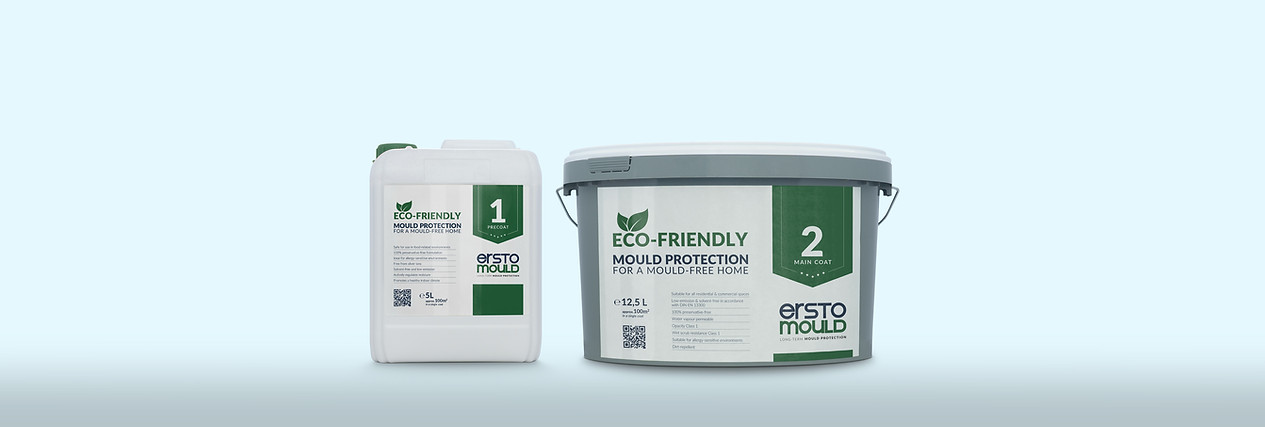
About erstomould
Mould protection with a system
erstomould is a functional coating system for the treatment and prevention of mould growth on mineral interior surfaces. The system was developed to functionally integrate, encapsulate and neutralise visible mould growth as well as near-surface and deeper mycelial structures, and to stabilise the treated surface in the long term.
erstomould is not a conventional coating intended simply to cover mould-affected surfaces. The coating is part of a holistic ERST system for mould, moisture, surface stabilization, and indoor climate.

Product function

How does erstomould work?
Mould often results from increased humidity, condensation, thermal bridges, critical surface temperatures, or inadequate air circulation.
This is exactly where erstomould comes in: The product not only treats visible infestation, but also supports the functional stabilization of the affected surface.
The specially developed coating penetrates the near-surface capillary structure and functionally binds existing mould and mycelial structures. After drying, a vapour-permeable, resistant functional film is formed, which protects the surface and can help reduce the recurrence of mould growth.
A prerequisite for long-term stability is always the professional assessment and elimination of the cause of the mould infestation.
Operating principle and technology
How does erstomould provide sustainable protection?
erstomould is based on a biophysical, film-forming mode of action. Existing mould growth and mycelial structures are functionally integrated and encapsulated within the coating. This inhibits further growth and supports the stabilisation of the treated surface. The mode of action is based on the functional properties of the coating rather than aggressive chemical pre-treatment.
The system supports:
-
neutralizing visible mould infestation
-
the functional integration of near-surface mycelial structures
-
stabilization of stressed surface areas
-
the reduction of the risk of recurrent mould growth when the underlying cause is properly addressed
-
vapour-permeable moisture regulation at the surface


Features and benefits
-
functional coating system for mould neutralisation and prevention
-
Direct application on mold-infested surfaces according to system description
-
Functional integration and neutralization of near-surface mycelial structures
-
Encapsulation of stressed capillary areas
-
vapour-permeable and supportive of building-physics performance
-
supports the moisture balance of the surface
-
moisture-regulating and surface-stabilising
-
high coverage and robust
-
Hiding power class 1
-
Wet abrasion class 1
-
washable and cleanable
-
solvent-free and odourless
-
free of silver ions and nanoparticles
-
suitable for sensitive interiors
-
Suitable for food-related areas after proper processing and drying, according to the test report.
-
compatible with other ERST systems
-
Part of a holistic mould, moisture and indoor climate concept
Downloads
Product brochure
Technical data sheet erstomould
Areas of application

Residential & Private Properties
-
Living and sleeping areas
-
children’s rooms
-
Basement rooms, stairwells
-
Garages, attics

Trade & Industry
Storage and production areas
Medical practices and hygiene areas
Food-related environment

Typical problem areas
-
Interior surfaces of external walls
-
thermal bridges
-
Rooms with ventilation deficiencies
-
Areas with condensation
FAQ
Frequently asked questions about erstomould
Can erstomould be applied directly to mould?
Yes, erstomould is designed for the functional treatment of mould-infested surfaces according to the system description. However, loose or unsound layers must be removed.
Is erstomould suitable for sensitive interior spaces?
Yes, erstomould is solvent-free, odourless, free of silver ions and nanoparticles, and suitable for sensitive interiors after proper processing.
Can erstomould be used in food-related areas?
After correct application and complete drying, the system is suitable for food-related areas in accordance with the relevant test report. Specific application depends on the location, substrate, use, and approved documentation.


